
Scrunch AI review: is it the best GEO tool in 2026?
What makes this genuinely useful is the prompt-level forensics. You can drill into a single high-value query, see every day's response, and track changes after a content update. That granularity is real.
REVIEWS
Derek Callahan
6/5/20268 min read
Key takeaways:
Scrunch AI tracks brand visibility across 7 major AI platforms: ChatGPT, Claude, Gemini, Perplexity, Google AI Mode, Google AI Overviews, and Meta AI
Starter plan runs $300/month (or $250/month billed annually); a 7-day free trial is available with no credit card required
The GA4 AI traffic dashboard and citation-level tracking are the standout features; the Agent Experience Platform (AXP) is compelling in theory but controversial in practice
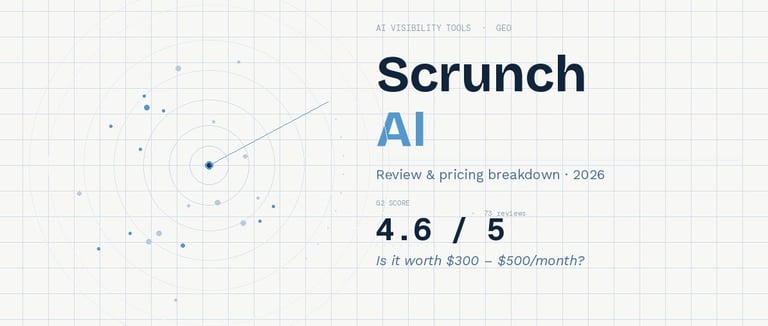
G2 score: 4.6/5 from 73 verified reviews; most complaints center on reporting gaps, prompt credit consumption, and limited export options
Best fit for agencies and enterprise teams; hard to justify for solo marketers or startups with thin budgets
Competitors like Profound, Peec AI, and Semrush's AI Toolkit are worth comparing before you commit
What is Scrunch AI?
Scrunch AI is a Generative Engine Optimization (GEO) platform. It monitors how your brand shows up inside AI-generated answers across ChatGPT, Perplexity, Gemini, Claude, and the rest. Founded in 2023, it came out of stealth in March 2024 and has grown to 500+ brand customers, including Lenovo, Skims, Crunchbase, and Penn State.
The company raised a $4M seed from Mayfield with backing from TJ Parker (PillPack), Bryant Chou (WebFlow), and Clara Shih (Meta AI). In 2025 it closed a $15M Series A led by Decibel. That's real money behind what's still a young product.
The core pitch is simple: traditional SEO tells you how you rank on Google. Scrunch tells you whether ChatGPT even mentions you when someone asks a question you should own.
I haven't personally used the paid dashboard, but I've spent time with the free trial, dug into customer reviews, and compared it against the main alternatives. Here's what I actually found.
5 core features, evaluated honestly
1. AI visibility monitoring
Scrunch runs your target prompts through 7 AI engines daily and tracks how often your brand appears, where in the answer it lands, and how sentiment shifts over time. You can segment results by buyer persona, funnel stage, and geography.
What makes this genuinely useful is the prompt-level forensics. You can drill into a single high-value query, see every day's response, and track changes after a content update. That granularity is real.
What I like:
Tracks 7 platforms, including Google AI Mode (most competitors cap at 4-5)
Persona and funnel-stage segmentation goes beyond what basic trackers offer
Daily updates give you a decent feedback loop
What I don't like:
Scrunch converts your keywords into prompts rather than tracking what users actually type. So you're monitoring an approximation of real queries, not real queries
Auto-generated prompts skew too branded. You end up manually adding the competitive MOFU/BOFU terms anyway
Prompt credits run down fast. Each LLM counts as one prompt use, so tracking one query across 7 engines burns 7 credits
2. Citation intelligence
For every prompt you track, Scrunch maps out which domains are getting cited in AI answers. You see competitors' citation share, which third-party sites AI pulls from, and where you're absent from the source chain.
This is probably the most actionable feature in the platform. If 80% of citations for your target keyword come from 3 industry blogs, that's your digital PR roadmap.
What I like:
Source-level visibility is rare at this price point
Competitor citation share shown in one dashboard
Useful for PR and content strategy decisions
What I don't like:
Can't sort the citation table by brand mentions or filter by brand mentioned in answer (flagged by multiple users)
Export is clunky; some data only comes out via API
3. GA4 AI traffic dashboard
Scrunch integrates with Google Analytics 4 to show you how AI crawlers are hitting your site: which bots (GPTBot, ClaudeBot, etc.), crawl frequency, and AI-driven referral traffic. This data technically exists in GA4 already, but Scrunch pulls it into a clean, presentation-ready view.
For client reporting, this saves real time.
What I like:
Presentation-ready charts you can drop straight into a deck
Tracks referral traffic from AI, not just crawlers
Agent traffic breakdown is something most tools don't offer at all
What I don't like:
GA4 integration has a known bugginess issue when switching between multiple properties
Doesn't show which specific page got traffic from which engine on the same view
Cloudflare CDN integration is picky for some setups
4. Page audits and AI-readiness
Scrunch audits pages for AI-friendliness: whether AI bots can read your JavaScript-heavy site, whether structured data is missing, whether content is formatted so LLMs can actually extract meaning from it. Starter gets 5 audits per month; Growth gets 10.
The audit surfaces real issues. The problem is most of the fixes require a developer.
What I like:
Catches technical crawlability problems most SEO tools miss
Good for JavaScript-heavy sites where AI bots struggle with rendering
Flags actual errors vs. just recommendations
What I don't like:
Only 5 audits per month on Starter
Fixes are dev-level, not content marketer level
Results feel like a starting point, not a complete picture
5. Agent Experience Platform (AXP)
AXP is Scrunch's most ambitious feature. It sits between your CDN and AI crawlers and serves a lightweight, structured version of your site specifically to AI agents, without touching the human-facing version.
The theory is smart. Many sites built on React or Vue.js are essentially unreadable to AI bots. AXP solves that without a full rebuild.
But this feature raises real questions. Serving different content to bots than to users is the definition of cloaking, and Google has penalized that practice for 20 years. Scrunch argues AXP is fundamentally different from cloaking, and that argument has merit in the context of AI agents vs. search crawlers. Still, I'd want independent evidence that it works before betting my SEO on it.
AXP is also still in limited rollout. Most customers can't access it yet. I wouldn't let it drive your buying decision.
What I like:
Addresses a real problem for complex JavaScript sites
Doesn't require a full site rebuild
Built for AI agents specifically, not retrofitted from general SEO logic
What I don't like:
Cloaking concerns are legitimate and worth monitoring
Still in limited testing as of mid-2026, with no firm public timeline
No visibility into what the AI-optimized pages look like after AXP generates them
Pricing breakdown
Additional user seats cost $25/month. For a 15-person team on the Growth plan, you're looking at over $1,000/month quickly.
There's a 7-day free trial on the Starter plan: no credit card required, includes 350 custom prompts and 3 personas. That's a fair window to test the monitoring core, though AXP and some enterprise features aren't included.
Annual billing saves you 17%, effectively 2 months free.
Who should buy Scrunch AI (and who shouldn't)
Good fit:
Agencies managing 3+ brands who need a multi-workspace setup and client-ready dashboards
Enterprise marketing teams with budget for dedicated AI monitoring
Competitive B2B categories where AI search is already influencing the buying journey
Teams with developer resources to act on AXP and page audit findings
Skip it if:
You're a solo marketer or at a bootstrapped startup. The $300/month entry is steep when manual prompt tracking is free
You expect an end-to-end optimization tool. Scrunch monitors and advises; it doesn't write content or execute fixes
You want to wait for AXP to mature before paying for it
You need no-frills reporting you can export as a PDF in one click (it can't do that yet)
What users actually say
G2 has 73 verified reviews on Scrunch AI with a 4.6/5 average. About 76% are five stars.
Dave D., Head of SEO/GEO at an Enterprise company (5/5):
"I reviewed several GEO monitoring tools. Scrunch not only has the most intuitive interface of all I looked at, but it's easy to dig into the advanced underbelly and surface action items ranging from quick wins to content strategy directions."
Tyler B., Digital Marketing Director (5/5):
"I've tested no less than 10 AI search visibility tracking tools, and Scrunch is by far the best group. Super easy to use, and very intuitive platform."
MJ F., Senior Product Manager (3.5/5), one of the more balanced reviews on the platform:
"The product itself is solid. Dashboard is clean and well-designed, the API returns full response text with citation URLs, and competitor tracking shows position and sentiment, not just presence... The sales process was frustrating. Terms shifted multiple times during negotiation. Get everything in writing and verify every line of the contract before signing."
Tehra P., Owner/president of a small digital agency (4.5/5):
"There's no good way to generate reports using Scrunch. I'm not advanced enough to figure out how to use the API to feed data into reporting tools. The dashboard is nice, though, and I've been able to give my clients view-only access."
Outside G2, Phil Belleville (Omaha SEO, 25-year SEO practitioner) put it plainly after testing it: "Scrunch AI is a powerful, feature-rich tool for a very specific user, but for most agencies and small businesses, it's an over-engineered and expensive solution to a problem that can often be solved more simply."
Sreyashi Chatterjee of GrowthPact, who tested it hands-on, framed it well: "If you're a one- or two-person marketing team at an early-stage startup, you don't need Scrunch. You can do this manually... But if you have the resources, money, time, and developer support, Scrunch starts making sense."
What Reddit says
Reddit has caught up to Scrunch AI, mostly in marketing-adjacent subreddits where people are figuring out GEO for the first time. The sentiment is genuinely mixed, which I think is more honest than the G2 profile suggests.
r/b2bmarketing — "I found 15 AI visibility tools in the market right now"
One commenter pushed back on Scrunch's outsized reputation in the space:
"Interesting, I've heard so many people talk about Scrunch almost [to the exclusion of other tools], paying influencers to push it."
It's worth keeping in mind. Scrunch has a visible marketing machine, and some of what surfaces online is affiliate-driven. That doesn't make the tool bad, but it's worth separating the signal from the promo.
r/b2bmarketing — "I tested 4 AI visibility tools for 30 days"
The thread itself is a thorough comparison. The general consensus in the comments: Scrunch has the best interface and the broadest coverage, but its monitoring-only approach leaves teams needing a second tool to act on the findings.
One comment that stuck with me: "Most of them just really didn't show anything. We did notice most of them turned out to be API calls so all the citations turned out to be either missing or not real, so we couldn't really do anything with it."
Scrunch's approach of actually querying the LLMs rather than relying solely on API approximations partly addresses this concern.
r/GEO_optimization — "Best GEO tools for tracking AI search visibility?"
80+ comments, and this thread is about as close as you'll get to an unbiased roundup of the GEO tools space. The top-voted answer:
"I started out initially with Profound. It gives you in-depth data but [it's] kinda overwhelming as it's..."
The point the commenter was making: Profound has more raw data; Scrunch has a cleaner experience. People in this thread use both depending on whether they prioritize depth or usability. Nobody seems to think one tool is obviously the winner.
My verdict
Scrunch AI is genuinely the most polished AI visibility monitoring tool I've come across at this price point. The dashboard is clean, the coverage is broad, and the citation intelligence gives you a PR roadmap most tools don't.
But "most polished monitor" is not the same as "best GEO tool." Scrunch tells you where you stand. It doesn't fix anything, write anything, or tell you exactly what to change. If your team can't close the loop from data to execution, you'll be paying $300-500/month for dashboards.
The AXP is the bet. If it works at scale and Scrunch can prove it doesn't come with SEO risk, this becomes a different product category entirely. As of mid-2026, it's still rolling out to select customers.
I'd recommend the 7-day trial to any agency or enterprise team already investing in AI search. For everyone else, start with the free version of a simpler tool and spend $300/month elsewhere until your AI search strategy actually needs this level of depth.
My rating: 4.1/5
Strong monitoring, clean UX, meaningful customer proof points. The gaps in reporting, export, and the unproven nature of AXP keep it from being a clear buy for everyone.

Contact:
© 2026 toolpundit. All rights reserved.