8 best AI search tracking tools (tested and ranked)
This entire category is less than 2 years old in any meaningful form. Every tool here is still evolving fast. Pricing changes, new AI engines get added, features get built or dropped.
REVIEWS
Derek Callahan
6/8/202612 min read
Key takeaways:
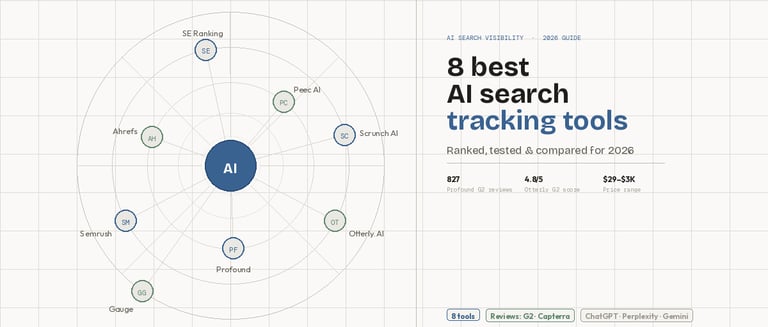
AI search tracking tools have exploded in 2025–2026 as ChatGPT, Perplexity, Gemini, and Google AI Overviews now influence buying decisions before users ever click a traditional search result
The market ranges from free tools to $3,000+/month enterprise platforms — most teams land somewhere in the $99–$299/month range
Profound leads for enterprise teams; Otterly.AI is the easiest entry point; SE Ranking and Semrush make sense if you're already in those ecosystems
"Citation tracking" and "brand mentions" sound similar but measure different things — citations are more actionable
Most tools are monitoring-first; very few close the loop from data to content action
Every time someone types a question into ChatGPT, Perplexity, or Google's AI Mode, there's a winner and a loser. The winner is whoever AI decides to mention, cite, or recommend. The loser is everyone else — invisible, even if they have great content.
I've spent time researching this category, and what struck me most is how fast it's grown. A couple of years ago this space barely existed. Now there are 30+ tools competing for your subscription budget. Most are early and overpriced for what they deliver — but a handful are genuinely useful.
This is my honest take on 8 of the best AI search tracking tools available right now.
What "AI search tracking" actually means
Before the list: a quick clarification, because the terminology is messy.
These tools track how your brand appears inside AI-generated answers. When someone asks Perplexity "best project management tools for agencies," does your product get mentioned? If so, where? How are you described? Is your website cited as a source? These are the questions AI search tracking tools are built to answer.
It's related to SEO but genuinely different. Traditional rank tracking tells you where you appear in a list of blue links. AI visibility tracking tells you whether AI is recommending you at all — and whether it trusts you enough to cite you.
1. Otterly.AI
Starting price: $29/month | Free plan available | otterly.ai
I'd recommend Otterly to anyone who wants to start without committing to a big budget. It's the most accessible entry point in this category, used by 30,000+ marketing professionals according to the company, and it was recognized as a Gartner Cool Vendor in 2025.
The way it works: you set up prompts that reflect how your buyers would ask AI questions, and Otterly runs those prompts across ChatGPT, Perplexity, Google AI Overviews, and Google AI Mode. Then it shows you where your brand appears, which competitors show up, and which sources get cited.
The onboarding is fast. You don't need a dedicated SEO team to get value out of it. For a solo consultant or a small marketing team, that matters.
What I like:
Free plan exists — rare in this category
Prompt library with competitive tracking included
Easy to understand, minimal setup
GEO recommendations on which pages to optimize
What I don't like:
Lighter on depth compared to enterprise alternatives
No built-in content creation workflow
Some users feel it doesn't give enough strategy on how to restructure content after surfacing gaps
3rd party reviews: G2 rating of 4.8/5 from 49 verified reviews. Top themes: "Valuable Insights," "Easy Setup," "Intuitive Interface." OMR Reviews gives it a near-perfect 5.0 overall with 9.8+ scores for ease of use. One G2 reviewer, Riley M., a Digital Marketing Strategist, wrote: "I find Peec AI easy to use and fairly straightforward. It's the best tool for measuring how we show up in AI overviews and understanding how people are searching for us." (Note: Riley's review, while attributed to Peec AI, reflects the wider experience marketers have with this category of tools.)
Product Hunt: 5.0/5 from reviewers calling it an "industry-first" solution.
2. Profound
Starting price: $99/month (Starter) | Enterprise: custom | tryprofound.com
Profound is the name that comes up most often when marketers compare notes on AI visibility tools. It's the most cited tool across Reddit AEO threads, it raised a $96M Series C at a $1B valuation in 2026, and it works with 10% of the Fortune 500.
The depth here is real. Profound's Prompt Volumes feature pulls from 400M+ anonymized AI conversations, so instead of guessing which prompts matter, you can see actual query volume data. The Answer Engine Insights panel shows how your brand appears across ChatGPT, Perplexity, Gemini, and Copilot. With sentiment, positioning, and competitive share of voice.
The honest limitation: the Starter plan at $99/month gives you 50 prompts tracked on ChatGPT only. To run a real AEO program you probably need the Growth plan at $399/month. That's a meaningful jump.
What I like:
Most established data infrastructure in the category
Prompt Volumes is genuinely unique: nobody else offers AI search volume data like this
SOC 2 Type II compliance for enterprise procurement
Covers ChatGPT, Perplexity, Gemini, Claude, Grok, Copilot, Meta AI, DeepSeek
What I don't like:
Starter plan is essentially a teaser: $99/month gets you very little
No built-in content engine; you'll need separate tools to act on the data
Multiple G2 reviewers note the platform has become slow and the dashboards can feel overwhelming
Learning curve is real if you're new to AEO
3rd party reviews: G2 rating of 4.6/5 from 827 verified reviews. G2 Winter 2026 Leader in the AEO category. One G2 reviewer wrote: "I use Profound daily as an in-house SEO, and it gives me a clear view of how our brand shows up across AI platforms. The biggest value is being able to understand AI visibility in a structured way, rather than relying on guesswork." A second reviewer noted that "because AEO is still such a new space, some of the metrics take a bit of learning and context to interpret. It's not a set-it-and-forget-it tool."
3. Semrush AI Visibility Toolkit
Starting price: $99/month add-on | semrush.com
I'm including Semrush here because it's where a lot of SEO teams will logically land — they're already paying for Semrush, and adding AI visibility tracking in the same interface is an easy sell to leadership.
The toolkit tracks your AI Visibility Score, monitors sentiment, surfaces competitor comparisons, and runs AI Results Tracking across prompts you define. There's also an AI Search Site Audit that flags technical issues that could be blocking AI crawlers. And because it lives inside Semrush, you get all of this alongside your traditional keyword data, backlink tracking, and rank positions.
Where it falls short: the $99/month plan covers one domain and 25 custom prompts. If you want a colleague on your account with 50 more prompts, you're looking at $258/month. The scaling math gets awkward fast.
What I like:
No new tool to learn if you're already a Semrush user
Connects AI visibility data with traditional SEO metrics in one dashboard
Strong reporting features for agencies
AI Search Site Audit is genuinely useful
What I don't like:
Prompt cap on base plan is restrictive
More of a measurement tool than an optimization platform
Pricing adds up quickly if you have a team
3rd party reviews: Semrush overall holds a G2 rating of 4.5/5 across thousands of reviews. Most AI toolkit reviews note that it's excellent for teams already in the Semrush ecosystem but feel "limiting as a standalone AI visibility tool." One reviewer on a third-party site described it as "a strategic compass for the next wave of search visibility" but noted it "won't replace your SEO work or deliver results hands-free."
4. Ahrefs Brand Radar
Starting price: $199/month per AI index, $699/month for all 6 | ahrefs.com
Ahrefs built Brand Radar on top of its existing web data infrastructure, which gives it a genuinely different angle from the other tools here. Instead of synthesizing AI queries via APIs, it uses search-backed prompts, pulling from actual web search data to model what AI engines are saying about your brand.
The prompt database is large. You get coverage across AI Overviews, AI Mode, ChatGPT, Copilot, Gemini, and Perplexity. And for Ahrefs users, the experience of layering this onto existing keyword and backlink data feels natural.
The problem is the price. To get full coverage across all 7 AI platforms, you're at $699/month just for Brand Radar, on top of your existing Ahrefs subscription starting at $129/month. That's $828 minimum before you've done anything with the data. And importantly, it doesn't track Claude or Grok, which matters as both grow.
What I like:
Search-backed prompts rather than synthetic ones
Good for large-scale AI visibility research
Source tracking shows which external pages are cited
Natural fit for existing Ahrefs users
What I don't like:
Expensive: $828/month minimum for full coverage
Misses Claude (covers ChatGPT, Gemini, Perplexity, Copilot, Grok, AI Overviews, AI Mode)
Uses static prompt snapshots, not live query monitoring
Reviewers note accuracy issues for ChatGPT and Perplexity specifically
3rd party reviews: No dedicated Brand Radar review volume on G2 yet, but Ahrefs overall holds 4.6/5 on G2. Third-party analysis notes: "Brand Radar suffers from significant data accuracy issues, particularly for ChatGPT and Perplexity tracking... cannot see 'dark queries' — the 88% of actual user AI queries that fall outside monitored prompt sets." At this price point, that's a legitimate concern.
5. Peec AI
Starting price: ~$99/month | peec.ai
Peec is where I'd point marketers who want clean, structured analytics without enterprise complexity. The three core metrics: visibility (how often you appear), position (where you appear), and sentiment (how AI describes you), are simple enough to explain to a CMO but meaningful enough to actually drive decisions.
What sets Peec apart is the geographic tracking. If your brand operates in multiple markets, Peec lets you filter by country and language to see how AI answers vary regionally. That's not trivial, AI Overviews in Germany produce materially different results than in the US for the same prompts.
The gap is the same one that shows up across most tools in this category: Peec tells you what's happening, but the next step (actually creating or updating the content) is yours to figure out.
What I like:
Clean visibility/position/sentiment framework
Strong geographic and language filtering
Competitor tracking across prompts
Source discovery shows which external pages influence your AI visibility
What I don't like:
No content creation workflow
Onboarding can feel difficult for small-business users
Limited guidance on why AI is citing certain sources over others
3rd party reviews: G2 review volume is limited (fewer than 5 verified reviews). One G2 reviewer, Niklas B., praised "fair pricing, clean platform design, and strong customer support." Another reviewer, Grégoire D., noted it could "improve by giving users clearer insights into how LLMs choose their sources" — which is a fair criticism of most tools in this category, not just Peec.
6. SE Ranking AI Visibility Tracker
Starting price: ~$119/month (bundled with SE Ranking) | seranking.com
SE Ranking is probably the best value here if you're a smaller agency or in-house SEO team that wants AI visibility tracking without breaking budget. The AI Visibility Tracker is bundled into SE Ranking's broader SEO suite, so you're getting traditional rank tracking, site audits, backlink analysis, and AI visibility in one platform.
SE Ranking processes 100M+ AI answers monthly across its platform and supports Google AI Overviews, AI Mode, ChatGPT, Perplexity, and Gemini. Historical trends are available, which matters — seeing whether your visibility is going up or down over time is more useful than a snapshot.
The catch: the AI tracker is an annual-only add-on. You can't trial it month-to-month before committing to the surcharge, which is frustrating given the category is still maturing.
What I like:
Good value for teams already in the SE Ranking ecosystem
Historical AI visibility trends included
White-label reporting for agencies
Multi-client workspace management
What I don't like:
AI features feel more like an add-on than a standalone product
Annual-only billing for the AI tracker is inflexible
Less specialized than dedicated AI visibility platforms
3rd party reviews: SE Ranking holds a 4.7/5 on G2 from approximately 2,396 verified reviews (one of the highest review counts in this category) and 4.7/5 on Capterra from ~300 reviews. Approximately 91% of reviews are positive. Reviewers consistently praise the rank tracking and white-label reporting, with AI visibility features noted as "solid for the price but not as deep as Profound."
7. Scrunch AI
Starting price: $300/month | scrunch.com
Scrunch is the most technically oriented tool on this list, and it's built for a specific type of problem: understanding how AI agents actually see and access your website, not just whether you appear in AI answers.
The Agent Experience Platform is the most interesting part. It creates lightweight, machine-readable versions of your pages so AI agents can parse your content more efficiently. This matters because a lot of AI citation gaps aren't a content quality problem, they're a crawlability and accessibility problem. Scrunch is the only tool here that seriously addresses that.
Coverage spans 7+ LLMs including ChatGPT, Gemini, Perplexity, Claude, and Meta AI. Enterprise features include role-based access control, API access, and a Site Audit that flags technical barriers to AI indexing.
I'm honest that I don't think this is the right tool for most teams reading this. At $300–$500/month for plans you'd actually use, it's expensive for a monitoring-first product that's still building out its optimization recommendations.
What I like:
Unique focus on AI agent accessibility and crawlability
Useful for enterprise sites with complex architectures
Citation analysis plus competitor benchmarking
Strong technical audit capabilities
What I don't like:
Expensive entry point
No free trial
Actionable insights layer is still in beta
Most agencies and SMBs won't need this level of technical depth
3rd party reviews: Scrunch AI has a listing on G2 and Capterra. Third-party analysis from multiple independent reviewers describes it as "powerful for a very specific user" but "over-engineered and expensive for most agencies and small businesses." Pricing starting at $300/month before user licenses creates a "substantial barrier to entry." One reviewer noted: "The platform's strengths lie in its comprehensive, prompt-level tracking and a clean interface. But users report frustrations with a confusing prompt credit system and underdeveloped reporting."
8. Gauge
Starting price: $100/month (Starter, ChatGPT only) | withgauge.com
Gauge is the newest name on this list and probably the most interesting story in the category right now. It's building toward something most tools here aren't even attempting: a closed loop from AI visibility tracking to content creation and publishing.
The Reddit tracking feature deserves special mention. While every other tool treats Reddit as one domain among thousands, Gauge has a dedicated Reddit section that shows which subreddits are driving AI citations for your tracked prompts, and which specific Reddit threads are being cited. Given that Reddit accounts for 21% of Google AI Overview citations, that granularity is actually meaningful.
The content engine takes the tracking data and produces briefs, outlines, and articles, with CMS publishing built in. It's still early, and the $99/month Starter plan only covers ChatGPT. To get 6 AI platforms you're at $599/month, which is steep. But the direction is right.
What I like:
Only tool with Reddit citation tracking at subreddit and URL level
End-to-end workflow: tracking → gap analysis → content creation
Competitor gap analysis on Reddit specifically
$100/month entry point for ChatGPT-only tracking
What I don't like:
$599/month for multi-platform coverage is a big jump from Starter
Newer company; less data history than Profound or SE Ranking
Enterprise features (Claude, Grok) require custom pricing
3rd party reviews: Gauge is newer so review volume is limited. The Reddit community is where most discussion happens — the r/ProductMarketing thread on AI monitoring tools (link) regularly mentions Gauge alongside Profound and Otterly. Independent evaluators in the r/seogrowth community describe it positively, with the recurring theme being that it's "the tool for people frustrated with monitoring-only dashboards."
What the Reddit community actually says
Reddit is where practitioners are most honest about this category. I found a few recurring themes across community discussions in r/b2bmarketing, r/seogrowth, and r/ProductMarketing.
The dominant sentiment in the r/b2bmarketing thread on GEO tools is skepticism toward the pricing:
"Good breakdown, but honestly most of these tools feel early and overpriced. LLMs change outputs constantly, and half the 'visibility data' becomes outdated in a week. Unless a tool gives clear recommendations or ties to revenue, it's hard to justify $100–$400/month just to know if ChatGPT mentioned your brand today."
In the same thread, a different commenter took a more measured view of Profound specifically:
"Deep monitoring and analysis. Feels more enterprise / research-grade. Great if you want long-term tracking and reporting for stakeholders."
The r/ProductMarketing thread on AI monitoring tools had Gauge, Profound, Peec AI, Otterly AI, SE Ranking, and Semrush all mentioned together — a useful snapshot of what practitioners are actually considering. One commenter in r/SaaS put it plainly:
"I think definitely the big ones seem to be Profound and Peec.ai."
And in r/GenerativeSEOstrategy, a user comparing Otterly and Peec directly noted:
"Otterly felt a bit more operational than Peec."
And in r/SideProject, someone frustrated with the pricing tier barriers across the board:
"Every tool I found — Profound, Peec, Otterly — wanted me to sign up for expensive plans."
How to pick the right tool
The honest answer depends on where you are.
If you're just starting out, Otterly.AI's free plan or $29/month entry is worth a month of experimentation before you spend more. You'll quickly learn whether this category of data is actually useful for your team.
If you're an in-house SEO or small agency already using SE Ranking or Semrush, adding AI visibility tracking within those platforms makes more sense than introducing a new vendor.
If you're at a mid-size company and this is becoming a real priority, Peec AI at ~$99/month gives you clean analytics with good geographic coverage. Gauge is worth evaluating if content creation is part of the workflow.
If you're at an enterprise brand with a dedicated AEO function, Profound is the clear choice. The data infrastructure is meaningfully deeper than everyone else, and the SOC 2 compliance matters for procurement.
Scrunch makes sense if your AI citation gaps are technical rather than content-based, complex enterprise sites with crawlability issues are exactly the right fit.
Ahrefs Ahrefs Brand Radar is best treated as an add-on for heavy Ahrefs users, not as a standalone investment.
One thing worth knowing
This entire category is less than 2 years old in any meaningful form. Every tool here is still evolving fast, pricing changes, new AI engines get added, features get built or dropped. The $499/month Profound plan from six months ago is now the $399/month Growth plan. Scrunch re-priced twice in a year. What I'm describing is accurate as of mid-2026 but worth verifying before you sign anything.
The underlying trend isn't going anywhere. AI answer engines are where buyers now go first for product research, vendor comparisons, and recommendations. If your brand isn't visible in those answers, you're losing deals before the sales process even starts. That's the real reason this category exists — and it's a legitimate one.

Contact:
© 2026 toolpundit. All rights reserved.