
Profound vs AirOps: which tool do you actually need?
I've spent time with both platforms, read through G2 reviews, Reddit threads, and third-party comparisons to build this piece. My conclusion: pick the tool that matches your actual bottleneck.
COMPARISONS
Derek Callahan
6/5/20268 min read
Key takeaways
Profound is an AI visibility monitoring platform. AirOps is a content production engine. They're built for different jobs.
Both have moved toward full-stack AEO platforms, but Profound leads on monitoring depth and AirOps leads on content execution.
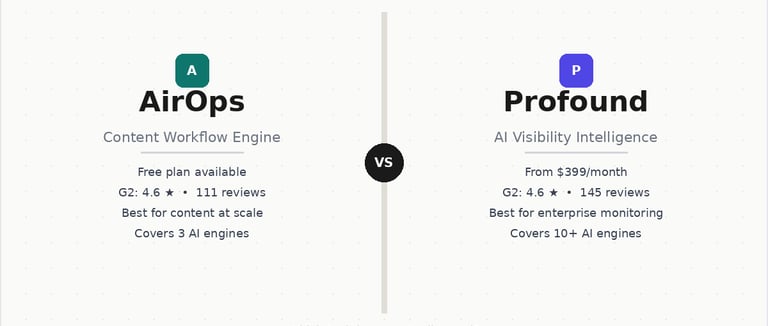
Profound tracks 10+ AI engines with near-real-time data. AirOps covers 3 engines on paid plans.
Profound's meaningful entry point is $399/month. AirOps has a free plan, but serious content workflows require their paid Scale plan.
Both rate 4.6/5 on G2: Profound with 145 reviews, AirOps with 111.
The answer to "which one?" depends entirely on whether your team's bottleneck is knowing what's happening in AI search or executing on it.
They're solving different problems
When this comparison comes up in marketing forums, people treat Profound and AirOps like two versions of the same product. They're not. Profound started as an AI visibility monitoring platform. AirOps started as a content workflow automation tool. Both have been adding features to plug their gaps, but the core DNA is still different.
I've spent time with both platforms, read through G2 reviews, Reddit threads, and third-party comparisons to build this piece. My conclusion: pick the tool that matches your actual bottleneck.
Here's the short version. Profound tells you where your brand stands in AI search. AirOps helps you do something about it at scale.
What Profound is
Profound is an AI search intelligence platform. It tracks how your brand appears across ChatGPT, Gemini, Perplexity, Claude, Grok, Meta AI, DeepSeek, and several other engines. You set up prompts relevant to your category, Profound monitors how AI answers those questions, who gets cited, what sentiment surrounds your brand, and how that shifts over time.
Its real edge is the Prompt Volumes feature: a dataset of 400 million anonymized real user conversations showing actual AI search demand. No other tool in this category has this. It tells you what people actually ask AI, which is different from what keyword tools tell you people search.
Profound also tracks AI crawler behavior on your site (Agent Analytics) and runs automated content workflows through its Agents module, which added a drag-and-drop builder, pre-built templates, and CMS publishing in late 2025. The company raised a $96 million Series C in February 2026 at a $1 billion valuation. Customers include Ramp, DocuSign, Figma, Target, and MongoDB.
G2 named Profound a Winter 2026 Leader in AEO. It holds 145 reviews at 4.6/5. SOC 2 Type II certification makes it viable for enterprise procurement in regulated industries.
What AirOps is
AirOps is a content workflow automation platform built for SEO and AEO teams. Think of it as a factory floor for content operations. You build multi-step workflows using a drag-and-drop interface (no code required), feed them into a "Grid" view that looks like a spreadsheet, and run hundreds of articles through that workflow simultaneously.
A typical AirOps workflow: pull SERP data from Semrush, analyze the top 10 results, generate a content brief, write a draft in your brand's voice, run a quality check, get human approval, then publish directly to WordPress or Webflow. Automated end to end.
The platform includes AI Search Visibility tracking (ChatGPT, Perplexity, and Gemini on paid plans), Brand Kits, Knowledge Bases for grounding content in your brand data, and Page360, which connects Google Search Console, GA4, and content freshness signals in one view.
AirOps has a free Solo plan with 20,000 tasks and basic ChatGPT visibility insights. Paid plans require a sales conversation. G2 shows 111 reviews at 4.6/5. Average time to implement: 2 months.
Feature-by-feature
AI engine coverage
Profound covers 10+ engines, with data refreshed every 15 minutes. AirOps covers ChatGPT, Perplexity, and Gemini on paid plans (ChatGPT only on the free Solo plan).
If you need to understand your brand's position across the full AI search landscape, this gap is significant. Profound tracks Grok, Meta AI, DeepSeek, and Bing AI. AirOps doesn't.
Content workflows
AirOps wins here, by a wide margin. Its Grid interface and Workflow builder are purpose-built for teams publishing at scale. Bulk content refresh, parallel processing, direct CMS publishing with one click. Profound added content capabilities through Agents and Profound Sheets, but content production is still secondary to its monitoring mission.
Data depth and intelligence
Profound wins here too. The 400 million prompt Prompt Volumes dataset has no equivalent in the category. Citation sentiment tracking, competitive share of voice, source authority data, and AI crawler analytics for your own site. AirOps' AI insights layer connects monitoring to action well, but it's not running this level of analysis.
Integrations and publishing
Both connect to WordPress, Webflow, and Contentful. AirOps also integrates Shopify and Semrush natively, making it more useful for e-commerce and SEO-heavy teams. Profound has stronger API infrastructure for enterprise workflows.
Security and compliance
Both hold SOC 2 Type II and GDPR compliance. Profound has the longer enterprise track record and is more commonly referenced in regulated industry procurement. For most teams, both are fine.
Pricing
This is where teams get surprised.
Profound pricing:
Starter: $99/month (ChatGPT only, 50 prompts)
Growth: $399/month (100 prompts, 3 engines)
Enterprise: custom
The Starter plan is barely functional for real monitoring. For multi-engine tracking with meaningful prompt coverage, you're looking at $399/month as your entry point. One independent analysis found Profound is 48% more expensive than the average AI visibility tracking tool.
AirOps pricing:
Solo: Free (20,000 tasks, ChatGPT only, 1 user)
Scale and Enterprise: contact sales
The free plan is real enough to actually test workflows. But the task-based billing model catches teams off guard. A single article in a serious workflow uses 500-800 tasks. A 30-article month burns 15,000-24,000 tasks. Teams scaling past the Solo plan often find themselves in a 10x pricing jump.
One G2 reviewer named KF put it bluntly: "AirOps is pricey. If you have the budget, it's totally worth the investment, but I know that most smaller teams might not be able to afford it."
Neither tool is cheap. Both are built for teams that have made content or AI search a real line item.
What I like and what I don't
AirOps
What I like:
The Grid interface works. Running 50 content refreshes in parallel while watching each row move through stages is the kind of operational feel that makes a content team faster.
Brand Kits and human-in-the-loop review points mean AI content doesn't drift from your voice.
The free plan is real. You can actually build and test workflows before committing money.
Direct CMS publishing saves hours of copy-paste work per week.
What I don't like:
The learning curve is steep. Most users describe a 4-6 week "click moment" before the tool makes sense. Some never get there.
Pricing opacity. No public rates for the Scale plan. You have to get on a sales call to find out what you'll pay.
At 500+ rows in a Grid, the interface lags. Heavy generation jobs need to be scheduled off-hours.
The AI visibility tracking is narrower than Profound's. If that's your primary use case, AirOps feels like a secondary feature.
Profound
What I like:
Prompt Volumes is the strongest competitive differentiator in the AEO category. The data comes from real user conversations, which is different from keyword research extrapolating intent.
Agent Analytics shows exactly how AI bots crawl your site and which pages get interpreted or skipped. A real asset for technical AEO work.
The Agents module has improved significantly. Content refresh, FAQ generation, competitive research all run on a drag-and-drop pipeline now.
SOC 2 Type II clears enterprise procurement in regulated industries where other tools can't.
What I don't like:
The interface is data-heavy. Multiple reviewers describe it as confusing without a dedicated analyst on the team.
Onboarding support is mixed. Positive reviews often come from teams with a Profound CSM. Solo users have a rougher time.
The Starter plan at $99/month is functionally a teaser. Real value starts at $399/month.
Actionability gap. Profound shows you the problem. Turning that into a content strategy is still your job.
What third-party reviewers say
AirOps on G2 (111 reviews, 4.6/5)
Sean M., Senior Director of Marketing Strategy and Operations at a mid-market company, wrote: "AirOps does a great job of bridging strategy and execution. It's not just about generating content faster, it's about building repeatable, scalable systems for content creation, refresh, and optimization that still leave room for human judgment."
Oleksii K., a Content Manager, said: "What I like best about Airops is the workflow automation. You set the workflow once and your marketing team can grow organic search and signups MUCH faster."
On the critical side, Loh Y., a Martech Manager, gave it a lower score: "The workflow builder is so unusable and it is taking me hours to figure out something simple. I just need to configure 3 steps in a workflow and it took me a day to figure things out."
Profound on G2 (145 reviews, 4.6/5)
Ankit P., Marketing Lead, appreciated the data but flagged a real gap: "It would be great to see more actionable recommendations derived from the visibility insights, making it easier to move from observation to optimisation."
Another reviewer praised the Agents feature specifically: "The agents feature is definitely a game changer for me. Agents allow me to simplify long tasks, and I can do audits, keyword research, analyse performance, and create reports, all in a matter of seconds."
The critical reviews circle the same issue: Profound gives you visibility data, but deciding what to do with it still requires significant internal expertise.
What Reddit users say
In a widely-referenced r/sidehustlewins thread, an agency owner who tested AirOps for 4 weeks wrote:
"I run a small content agency (3 writers, 12 clients, mostly SEO stuff). We've been using every AI tool under the sun. They're fine, but they're all basically the same: you type a prompt, get mediocre output, spend 2 hours editing, cry a little. I tried AirOps, and it's... actually good."
On Profound, a user in the r/b2bmarketing thread on GEO tools put it clearly:
"Deep monitoring and analysis. Feels more enterprise / research-grade. Great if you want long-term tracking and reporting for stakeholders."
A broader r/ProductMarketing discussion on AI monitoring tools surfaced a recurring frustration across the category:
"I've been testing different platforms to see which ones actually give useful data versus just noise."
The r/SEO community's consistent critique of both tools and their peers: these platforms show you what's happening in AI search but don't close the gap between insight and action. That's the honest state of the category in 2026.
Who should choose which
Choose AirOps if:
Your team publishes 20+ articles per month and the bottleneck is execution speed
You already have a proven content strategy and need a system to run it at scale
You're an agency managing multiple client content programs
You want to automate refreshes across hundreds of existing pages
You can handle a 4-6 week ramp-up before the tool becomes second nature
Choose Profound if:
You need full-landscape AI search monitoring across 10+ engines
You're in a regulated industry and need SOC 2 Type II compliance
You want Prompt Volumes data to inform your strategy before producing anything
You have dedicated analytics resources to interpret the platform's output
AI search competitive benchmarking is something your leadership reviews regularly
Skip both if you're a solo creator or early-stage startup. And if your content strategy is unclear, neither will fix that. AirOps scales what you already do well. Profound shows you where you stand. Both assume you've already figured out the basics.
My verdict
I'll be direct.
If I were building a content operation for a mid-sized B2B company, I'd start with AirOps. The free plan is real, the execution capabilities are strong, and the workflow builder makes sense once you climb the learning curve. The AI visibility tracking is a bonus, not the main reason to be here.
For an enterprise brand that needs to justify AI search investment to leadership, Profound is worth the $399/month Growth plan. The Prompt Volumes data alone changes how you prioritize content. And the enterprise security makes procurement easier.
I think the most honest framing: the best teams in 2026 probably use both. Profound surfaces what topics have AI search demand, Profound's competitive monitoring shows where your brand stands, and AirOps executes the content program at scale. That's a significant combined budget. Most teams aren't there yet.
Pick the one that solves the problem in front of you right now. If you're not sure which that is, start with AirOps' free plan for a week. The experience of building (or failing to build) your first workflow will clarify exactly what you need.

Contact:
© 2026 toolpundit. All rights reserved.