
best Peec AI alternatives in 2026
Peec AI raised $29M, built 2,000+ customers fast, and priced itself at €85/month. The G2 rating is 4.9/5 — but only 11 reviews. Community feedback consistently flags thin data depth and the absence of competitor research tools on par with Ahrefs.
ALTERNATIVES
Derek Callahan
6/9/20269 min read
Key takeaways:
Peec AI raised $29M, built 2,000+ customers fast, and priced itself at €85/month. The G2 rating is 4.9/5 — but only 11 reviews. Community feedback consistently flags thin data depth and the absence of competitor research tools on par with Ahrefs.
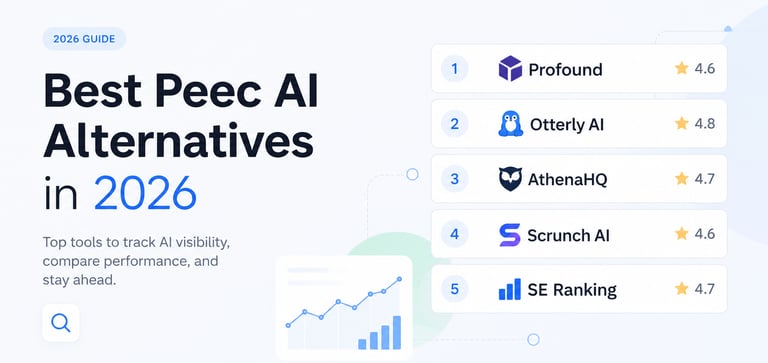
Profound is the enterprise standard: G2 4.6/5 (827 reviews), 400M+ real user prompts via Conversation Explorer, 10 AI engines tracked, $35M Series B from Sequoia. The Lite plan is $499/month for ChatGPT only, which is the main barrier for most teams.
Otterly AI has the strongest value at the entry level: $29/month, 4.8/5 G2 rating (250 reviews), Gartner Cool Vendor 2025, 6 AI platforms including Google AI Mode. The 10-prompt base tier is too thin for real work; budget for the $189/month Standard plan.
AthenaHQ (YC-backed) is the right pick for competitive prompt benchmarking across ChatGPT, Perplexity, Claude, and Gemini. The prompt leaderboard with competitor head-to-head is the differentiator at $295/month.
Scrunch AI approaches the problem differently: AI customer journey mapping, Knowledge Hub for brand information control, and misinformation correction. At $300/month, it earns that price only for specific narrative management use cases.
SE Ranking's AI visibility module (SE Visible) offers 450 prompts for $189/month with unlimited users and no add-on fees. The strongest option for teams already inside the SE Ranking ecosystem.
Peec AI raised $29 million, crossed 2,000 customers in under 18 months, and earned a 4.9/5 G2 rating. On paper, it looks like a well-built product for the job.
The community conversations run differently.
u/deviant1414 posted in r/GEO_optimization after using Peec AI for months:
"I've been using peec.ai for a few months now for measuring our brand visibility, but running into headaches recently and looking for other tools. I don't want to manually enter in all the prompts that need to be tracked. Data and insights generally feel thin. It's hard to put my finger on it, but the general feeling I get is that of brittleness and I don't feel like I get solid reliable data from peec."
The "brittleness" framing is something I kept encountering across different threads. The product works, but users don't feel confident acting on the data.
Meanwhile, the broader category has exploded. As u/madsenmining observed in r/GrowthHacking:
"There are so many AI SEO / AI visibility companies out there right now! I really like RivalSee I feel is one of the best in generating and using Personas and persona-specific queries. Profound is also supposed to be good if you are Enterprise as is Semrush, but man there are like 50 so just try a bunch and go with the one whose AI/UX you like the most."
50 is an exaggeration. But not by much. Here are the 5 worth your time.
1. Profound
Profound is what enterprise teams reach for when they need to explain AI visibility to a board. It raised $35 million from Sequoia Capital, earned G2's Winter 2026 AEO Leader designation, and has 827 reviews at 4.6/5. Those numbers mean the product has survived real scrutiny at scale.
The thing that genuinely sets Profound apart: Conversation Explorer. Most AI visibility tools track the prompts you define. Profound gives access to 400 million real user prompts, so you can find the conversations you didn't know you needed to track. For a large brand trying to understand how buyers actually ask questions about their category, that's a different product than a monitoring dashboard.
Ron M., Global Director of Digital Marketing, wrote on G2:
"How Profound allows us to track AI Visibility and visibility scores efficiently is invaluable. I love Profound's content engine; it empowers me to create content rapidly, often in under ten minutes, with full creative control. This feature enables me to draft, make revisions, add brand guidelines, and easily share completed content with my marketing team."
Anna S., Enterprise Content Marketing Manager, adds the honest caveat:
"The biggest challenge of Profound is that there's almost too much good data. We can slice and dice the info to see what's working for different business goals (like top of funnel vs acquisition), and we can even see how we stack up against our key competitors."
"Too much good data" sounds like praise. It's also a warning. If your team doesn't have the bandwidth to actually interpret the output, Profound becomes an expensive dashboard you open once a month.
The pricing is the real friction point. The Lite plan starts at $499/month, but that covers only 50 prompts on ChatGPT. Getting meaningful cross-platform coverage across all 10 engines: ChatGPT, Claude, Perplexity, Gemini, Copilot, DeepSeek, Grok, Meta AI, Google AI Overviews, and Google AI Mode - requires the Growth plan at $1,499/month or more. For most teams, that math doesn't work.
What I like:
400M+ real user prompts; no other tool offers this
10 AI engines tracked including DeepSeek, Grok, and Meta AI
SOC 2 Type II and HIPAA compliant for enterprise procurement and healthcare
G2 Winter 2026 AEO category leader with 827 reviews
Dedicated AI strategist support on paid plans
What I don't like:
$499/month gets you ChatGPT only; full cross-platform data requires $1,499+
Steep learning curve; multiple G2 reviewers flag this explicitly
No built-in content writing or optimization tools
Pricing: Lite plan $499/month (50 prompts, ChatGPT only). Growth plan $1,499/month (10 engines, 10 workspace seats).
G2: 4.6/5 (827 reviews)
2. Otterly AI
Otterly launched in October 2024 and grew to 30,000+ users within a year. Gartner named it a Cool Vendor for 2025, which is meaningful when the product that received the designation was barely 6 months old.
The case for Otterly is pricing and coverage together. At $29/month you get brand and citation monitoring across ChatGPT, Perplexity, Google AI Overviews, AI Mode, Gemini, and Copilot, plus sentiment analysis and link citation tracking. For a solo marketer establishing a GEO baseline, that covers the fundamentals.
I'd call Otterly a monitoring tool, not an optimization tool. It shows where you appear, how AI describes your brand, and where competitors are showing up without you. It won't tell you what content to build to change the picture. At this price, nobody should expect that.
The practical issue: 10 prompts on the base tier is barely enough to test the platform. Meaningful monitoring starts at the Standard plan ($189/month, 100 prompts). Budget for that from the start.
Otterly added a GEO Audit feature in April 2025 that analyzes 25+ on-page factors and delivers SWOT-style recommendations. It's a step toward actionability, and the product keeps developing.
What I like:
$29/month entry; 4.8/5 on G2 with 250 reviews
Gartner Cool Vendor 2025 for a product under a year old
6 AI platforms including Google AI Mode and Copilot
GEO Audit tool with 25+ on-page factor analysis
Quick setup; most reviewers note it's running in minutes
What I don't like:
10-prompt base tier is not workable; the Standard plan at $189/month is the real starting point
No content creation or optimization tools
Per-prompt pricing scales poorly for agencies managing 5+ clients
Pricing: Lite $29/month (10 prompts). Standard $189/month (100 prompts). Pro $989/month (1,000 prompts).
G2: 4.8/5 (250 reviews)
3. AthenaHQ
AthenaHQ is Y Combinator-backed, which matters because YC consistently produces product teams that build with real user feedback rather than category assumptions. The platform is focused on competitive prompt benchmarking across 4 AI engines: ChatGPT, Perplexity, Claude, and Gemini.
The feature that earns the price: prompt leaderboard tracking. AthenaHQ shows where your brand ranks across specific queries, with the ability to benchmark against up to 5 competitors simultaneously. For a competitive intelligence or demand gen team, that head-to-head view is the whole point.
I've seen Rootly's case study referenced showing 10x citation growth using Athena's recommendations. I can't independently verify the methodology, but the specificity puts it in a different category from generic "X% improvement" marketing claims.
Hallucination detection (the Lighthouse feature) is worth noting for regulated industries. It flags when AI models describe your brand inaccurately, so you can document and respond. For any brand with a complex or technically precise product, finding out that ChatGPT is describing you incorrectly is important information.
Where I'd choose Athena over Otterly: when you care more about competitive prompt benchmarking than price. The $295/month is roughly 10x the Otterly Standard plan, but the competitive comparison capabilities are genuinely different.
Where I'd pick Profound over Athena: when real user prompt volume, HIPAA compliance, or dedicated account support are requirements.
What I like:
Competitive prompt leaderboard against up to 5 rivals at once
Engine-specific filters to isolate ChatGPT vs. Perplexity performance separately
Hallucination detection (Lighthouse) catches AI misinformation about your brand
YC backing; active product development with regular updates
Region-based tracking for brands operating in multiple markets
What I don't like:
$295/month for monitoring only; no content tools
4 AI engines vs. Profound's 10
Report export still developing; flagged in user reviews
Pricing: Starts at $265–295/month. First-month discount available at time of writing.
4. Scrunch AI
Scrunch is doing something structurally different from the rest of this list. Where most GEO platforms ask "are we being cited?", Scrunch asks how users navigate toward or away from your brand through AI conversations. The AI customer journey framing is a genuine product distinction, not a repositioning of the same monitoring dashboard.
The Knowledge Hub is the feature I'd pay attention to. It lets you structure the information you want AI models to use about your brand, owned and third-party content. So AI engines have accurate, complete information to pull from. The misinformation correction workflow builds on this: when Scrunch detects AI generating inaccurate brand descriptions, it surfaces specific content actions.
For brand managers and PR teams focused on narrative control rather than citation counts, that's a different product than what Profound or Otterly offer.
In r/seogrowth, a user explained why they picked Scrunch over the cheaper options:
"I tried the Otterly plugin for SEMRush, it was useless. Scrunch isn't cheap, but I see this as a tool I'm only going to use more. It has competitor tracking, prompt upload, and a Looker Studio for referral visits from AI sources."
The Looker Studio integration is a practical detail for agencies that need to put client-facing reports together without exporting CSVs manually.
The $300/month barrier is real. For a team with basic monitoring needs, Otterly covers those for under $200/month. Scrunch justifies that price when you have specific use cases: narrative management, brand misinformation detection, or AI journey mapping that cheaper tools can't address. G2 reviewers at 4.6/5 (50+ reviews) consistently highlight the competitor share-of-voice comparison and multi-engine coverage.
What I like:
AI customer journey mapping; genuinely unique in this category
Knowledge Hub for proactively shaping what AI models know about your brand
Misinformation correction workflow
Covers ChatGPT, Gemini, Claude, Perplexity, and Meta AI
Looker Studio integration for agency client reporting
What I don't like:
$300/month is hard to justify for teams whose core need is citation tracking
No built-in content creation or optimization tools
Complexity is a barrier for teams without dedicated GEO staff
Pricing: $300/month (350 custom prompts, 1,000 industry prompts, annual billing available).
G2: 4.6/5 (50+ reviews)
5. SE Ranking
SE Ranking has 4.8/5 on G2 with 1,432 reviews as a full SEO platform. In 2025, they shipped SE Visible as a dedicated AI visibility product built on the same infrastructure. The answer to "who should use this?" is specific: teams already running SE Ranking for SEO who don't want a second tool in their stack.
SE Visible covers ChatGPT, AI Mode, Perplexity, and Gemini. It includes competitive benchmarking, a Net Sentiment Score (-100 to +100), prompt management, and source tracking. The Core plan is $189/month for 450 prompts and up to 5 brands, with unlimited users across all plans. That prompt-to-price ratio is genuinely strong for this category, most competitors charge more per prompt and add per-seat pricing on top.
The honest question: if you're not already in the SE Ranking ecosystem, does SE Visible make sense as a standalone GEO tool? Probably not. Profound and AthenaHQ offer more AI engine coverage and deeper specialized features at comparable price points. But for an SEO team with SE Ranking already installed, consolidating AI visibility into the same platform is a legitimate reason to choose this.
What I like:
450 prompts at $189/month; best value per prompt in this comparison
Unlimited users on all plans
Net Sentiment Score gives a clean summary metric for brand perception
10-day free trial before committing
Built on SE Ranking infrastructure; proven product quality and support
What I don't like:
4 AI engines vs. Profound's 10
CSV-only export in the current version; broader export formats in development
Less specialized than purpose-built GEO tools if you're not using SE Ranking already
Pricing: Basic $99/month (200 prompts, 3 brands). Core $189/month (450 prompts, 5 brands). Plus $355/month (1,000 prompts, 10 brands).
G2 (SE Ranking platform): 4.8/5 (1,432 reviews)
Which one to pick
Otterly if you're starting out and want low-cost monitoring across 6 AI platforms. Budget $189/month for the Standard plan rather than the $29/month base tier.
AthenaHQ if competitive prompt benchmarking matters more than price. The prompt leaderboard with competitor context is the main reason to pay 10x more than Otterly.
Scrunch if your concern is AI narrative control, brand misinformation, and customer journey mapping — not citation counts.
SE Visible if you're already running SE Ranking and want GEO data without switching tools.
Profound if you're at enterprise scale, need HIPAA or SOC 2 compliance, and want the deepest real-user prompt data in the category.
The category is still moving fast. Most tools that launched in 2024 are meaningfully different products today. Whatever you pick, plan to revisit the decision in 6 months.

Contact:
© 2026 toolpundit. All rights reserved.