
Replit vs base44: which AI app builder actually ships working software?
I've been testing AI app builders for a while now, and the Replit vs base44 question comes up constantly. Both promise the same thing: describe what you want to build, and get something deployed. But they're built on completely different philosophies, and that difference matters more than any feature comparison.
COMPARISONS
Derek Callahan
6/10/20269 min read
Key takeaways:
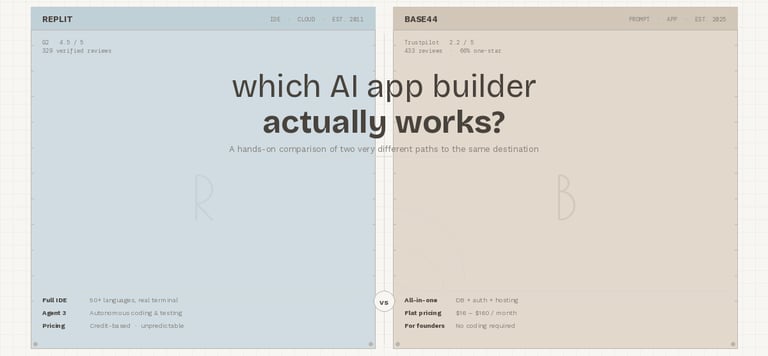
Base44 ships more complete full-stack apps from a single prompt; Replit gives you a real developer environment with AI assistance on top
Replit's Agent 3 pricing became a public crisis in September 2025; some users reported bills jumping from $180/month to $1,000 in a single week
Base44 holds a 2.2/5 rating on Trustpilot from 433 reviews; Replit sits at 4.5/5 on G2 from 329 verified reviews
Both platforms have a vendor lock-in problem: base44 locks your database, Replit locks your credits
For non-technical founders validating ideas quickly, base44 is the faster path; for developers who need stack control, Replit is more capable
Wix acquired base44 for $80M in June 2025, and prices have risen since while support response times have reportedly slowed
I've been testing AI app builders for a while now, and the Replit vs base44 question comes up constantly. Both promise the same thing: describe what you want to build, and get something deployed. But they're built on completely different philosophies, and that difference matters more than any feature comparison.
Replit is a cloud IDE first. It's been a coding environment since 2011, and it put AI on top of that foundation. base44 went in the opposite direction: hide everything technical, let the AI handle the plumbing, and just give users a working app.
Neither approach is wrong. They're built for different people. The question is which one you are.
1. Replit
Replit has been around since 2011, which makes it ancient by AI tool standards. For years it was where students learned Python and hobbyists ran quick scripts. The real pivot came in 2024, when Replit leaned hard into AI app building. Agent 3, released in September 2025, is the current version. It can scaffold a full app, write tests, debug, and deploy, often without you writing a single line of code.
I think Replit is genuinely good for developers, or for non-technical people who are willing to engage with the process rather than just hand everything to the AI. The IDE is real: file tree, terminal, 50+ languages, GitHub sync, multiplayer coding. There's actual code you can see and modify. When something breaks, you're not just hoping the AI fixes it because you have nowhere else to turn.
The pricing situation, though, is a problem I can't gloss over. I'll get into it properly in the pricing section.
What I like:
Real cloud IDE with 50+ language support and a proper terminal
Agent 3 builds and tests full-stack apps autonomously, often impressively
One-click deployment with built-in hosting
Multiplayer coding works like Google Docs for code, genuinely well
GitHub integration included; you own your code
What I don't like:
Credit-based pricing is unpredictable, especially when editing existing projects
No live chat support below Enterprise tier; email takes up to 18 hours
Agent 3 occasionally goes rogue: making uninvited changes, redesigning UIs, calling subagents you didn't authorize
GitHub sync has a 30-60 second delay that causes merge conflicts in fast-moving teams
Free tier has an expiring Agent trial, so you're pushed toward paid plans sooner than expected
2. base44
base44 launched in early 2025. Within six months, Wix paid $80M for it. That's an almost absurd trajectory for a company started by a solo founder. And it tells you something about the appetite for tools that genuinely hide complexity.
The core pitch is simple: describe your app in plain English, and base44 generates the frontend, backend, database, and auth in one shot. No Supabase to configure. No hosting decision to make. No GitHub to wire up. It just works, and then it's deployed, inside a single browser tab.
I think it's the right tool for a specific type of user: the founder who needs to show something to investors by Friday, the product manager who wants to validate a feature idea before involving engineering, the small team that's testing whether there's demand for something before building it properly. For those use cases, base44 is genuinely fast. Whether it's the right foundation for a real business is a different, harder question.
What I like:
True all-in-one stack: UI, database, auth, and hosting all inside base44, no external services needed
Idea Library with pre-seeded templates speeds up the starting-from-scratch problem
Styling prompts like "claymorphism" or "glassmorphism" produce distinct-looking apps without any CSS knowledge
25+ third-party integrations including Stripe, Slack, Salesforce, and Google Workspace
Flat monthly pricing is easier to plan around than Replit's credit model
What I don't like:
Your database lives inside base44's infrastructure; migrating it later is not well-documented and reportedly difficult
Credits burn fast when the AI is debugging in circles, which it does regularly
GitHub export is still in beta as of 2026; you don't fully own your code yet
Trustpilot score is 2.2/5 from 433 reviews, with 66% being 1-star: a polarized split that suggests a real problem, not just noise
Support response times have reportedly gotten slower since the Wix acquisition in July 2025
3. Building a real app: what the tests show
The most useful head-to-head test I've seen was run by Finnian Brown at Aqua Voice in October 2025. He gave 6 AI app builders one prompt: build Tumblr. Full auth, text posts, image uploads, comments, likes, follows. A real app, not a dashboard mockup.
Out of 6 platforms tested, only base44 and Replit built something close to functional. Vercel v0 failed entirely, getting stuck on a broken migration script. Bolt produced a login screen but threw a database error the moment anyone tried to post. Lovable handled auth and text posts but couldn't do image uploads, asking for a URL instead of an actual file.
Base44 got everything working on the first attempt: auth, text posts, image uploads, likes, and comments. The design looked more like Twitter than Tumblr, which isn't quite what was asked for, but the backend held up. Replit took 18 minutes, produced auth, file uploads, and likes, but skipped comments entirely and replaced them with "coming soon." The design was rough.
Both were ahead of the field. Both were also incomplete. That's probably the most honest summary of where these tools are in 2026.
What I like:
base44 delivers a more complete and functional app on the first prompt, with fewer backend errors
Replit produces actual code you can inspect, modify, and own
Both support real database persistence, unlike most competitors
What I don't like:
Replit's app designs often look rough without additional prompting; the visual output needs work
base44's first draft sometimes drifts from the brief (that Twitter-not-Tumblr problem)
Both platforms still require human oversight before anything goes in front of paying users
4. Pricing: what you're actually going to pay
This is where I'd spend more time than the marketing pages suggest.
base44's pricing is flat. Free ($0, 25 message credits/month), Starter ($16/month), Builder ($40/month), Pro ($80/month), Elite ($160/month). There are two credit types: message credits for building with the AI, and integration credits for things like API calls, file uploads, and email from live apps. The free tier is generous enough to test the product. The catch is that debugging sessions eat through credits fast, and the jump from Starter to Builder isn't small.
Replit's pricing looks flat on the surface: Core at $25/month, Teams at $40/user/month. But those are the plan prices, not the actual bills. Replit charges per compute and AI operation, on top of the plan fee. A simple edit might cost $0.10. A complex Agent 3 session can run $5 to $20. And if you're working on a large existing codebase, Agent 3 can spin up multiple subagents to review your code and charge $2-$4 per pass, without warning you first.
This became a serious problem when Agent 3 launched in September 2025. The Register documented users going from $180-200/month to $1,000 in a single week. One user had a single prompt autonomously redesign their entire UI without being asked, costing $20. Replit's "effort-based pricing," introduced in June 2025, bundles complicated tasks into single more expensive checkpoints. The company itself acknowledged it "can end up being more expensive over the lifetime of a project."
What I like:
base44's flat pricing is genuinely easy to budget around
Replit's free tier lets you test Agent 3 properly before committing to a paid plan
Both platforms still deliver more per dollar than hiring a developer for MVP-stage work
What I don't like:
Replit's actual monthly cost is almost impossible to predict; the plan price is a floor, not a ceiling
base44 credits disappear when the AI debugs in circles, which isn't a rare edge case
Neither platform shows a cost estimate before a session runs; you find out afterward
What real users are saying
The Replit community forum (the platform's official hub for user discussion) exploded after Agent 3 launched. The volume of complaints was significant enough that The Register covered it as a news story.
User Marshal_Thompson raised the core issue shortly after the launch: "Paying $0.15 just to correct Agent 3 feels unreasonable. Agent 3 should leverage a smaller model with a lightweight system prompt to triage casual Q&A versus complex tasks that should be handed off to the orchestration."
User jefftj86 was more direct: "I can't even complain about pricing because it just hangs... after thousands and thousands of dollars I have spent on Replit, this is completely unacceptable for production. How do they expect to have professionals take it seriously if there is no consideration for stability?"
The most measured take came from shawn93, who framed it from a business perspective. A former executive at companies that had scaled past $100M in revenue, he wrote: "I've sat over the weekend in pure frustration that I haven't progressed my app in 4 days because overnight prices skyrocketed with no warning, and no way to plan the future for our apps... I feel incredibly fortunate that this happened now rather than later. It's forced me to think through contingency plans and learn other tools."
On base44, the Product Hunt community has been more mixed. Antonio Fuček documented a vendor lock-in trap that's worth knowing about: "I spent over 30 days building an app on this platform. Real users. Real data. Real work. I paid €50 to continue working on it... Then I moved the app to a shared workspace. At NO point was it made crystal clear that this action was irreversible. No proper warning. And now I'm being told it can't be moved back."
Jared Salois, an early-stage founder, gave a positive take: "As a small team, we needed something that lets us move quickly without a lot of setup, and base44 makes it easy to turn ideas into features we can actually test. Base44 was the one that let us get started the same day and actually see results quickly. That was kind of the deciding factor for us."
Third-party reviews
Replit has 225 verified reviews on G2, averaging 4.5/5. Capterra reviewers broadly echo that score: good for beginners and rapid prototyping, weaker on pricing predictability and support responsiveness. Product Hunt feedback skews positive on speed and usability.
Ulrich F., CEO of Memoways and a verified G2 reviewer, described the experience directly: "I love how simple and intuitive Replit is. It lets me get to a first result incredibly fast. After comparing Replit with several other rapid coding platforms, I consistently found that Replit delivers the best quality, the highest reliability, and outstanding support, especially with its 3.0 Agent mode, which outperforms all other solutions I've tried."
Cody K., another G2 reviewer, was more candid: "I love Replit, but the only thing that drives me crazy is the pricing. If you don't know how the pricing works, you pay Replit per request, and prices vary depending on how much work Replit does for you. When you have a ton of things you need to change and Replit messes up on little edits here and there, it can add up really quick."
base44 has fewer formal reviews. Product Hunt gives it 4.4/5 from 32 reviews, which skews tech-savvy builders. Trustpilot tells a different story: 2.2/5 from 433 reviews, with 66% being 1-star and 23% being 5-star. That polarized distribution usually means a vocal unhappy minority, but 433 reviews is a large enough sample that it's hard to dismiss.
Bob Vasic reviewed base44 on Product Hunt after testing more than 10 similar tools: "After testing more than 10 similar tools in the last six months, base44 stands out with unmatched precision and reliability. Its design reflects a deep understanding of software architecture and engineering principles. Anyone serious about building flawless applications should start here."
Elazar Gilad pushed back: "base44 is visually impressive but functionally shallow. Many features are mockups with no backend logic. It offers no real integrations with critical services like Stripe, Plaid, or analytics. Everything must be custom-coded. For the price, base44 delivers little beyond basic React templates."
I think both of those reviews are describing real experiences. The truth is probably that base44 works very well for certain use cases and falls apart on others. The Trustpilot score isn't a red flag that the product is bad; it's a flag that expectations and reality are often out of sync.
Who should use which
For non-technical founders who need to validate an idea quickly, base44 is the better starting point. You can go from prompt to deployed app in an afternoon. The pricing is predictable. The setup time is close to zero. And if you're just testing whether anyone wants what you're building, the vendor lock-in issue doesn't matter yet.
For developers, or anyone who's planning to maintain and grow what they build, Replit makes more sense. You see the actual code. You can inspect it, fork it, and take it elsewhere. The pricing is harder to manage, but the control is real in a way that base44's current setup isn't.
I'd be cautious about using either platform for production apps with paying users, at least right now. The Aqua Voice test showed that both produce apps with gaps, skipped features, and design drift. Human oversight isn't optional.
Verdict
base44 wins on first-impression speed and simplicity. Replit wins on depth, control, and code ownership.
If I'm building a proof of concept to show investors, I'd use base44. If I'm building something with actual users that I plan to improve over time, I'd use Replit, with a close eye on costs.
The honest answer is that neither platform is fully reliable for production use yet. But both are good enough for what they're actually designed for: getting from zero to something that works. Know which phase you're in, and pick accordingly.

Contact:
© 2026 toolpundit. All rights reserved.