
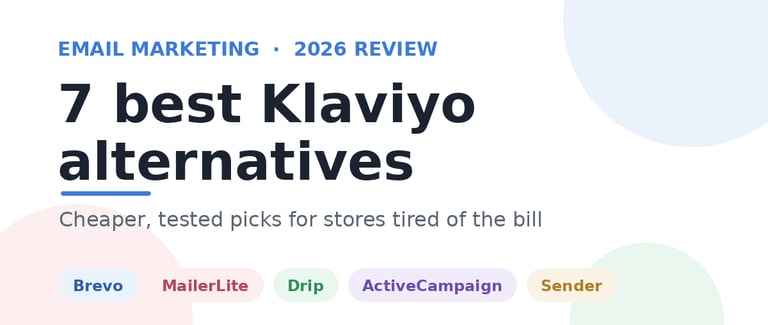
7 Klaviyo alternatives I'd actually recommend
It's the pricing curve. Klaviyo charges by the number of profiles in your account, and that number only goes up. You add a profile every time someone checks out, subscribes, or abandons a cart, and most stores never prune the list. So the bill climbs even in months when sales don't.
ALTERNATIVES
Derek Callahan
6/12/202610 min read
Key takeaways
Klaviyo is still one of the best ecommerce email tools out there. The problem is the bill. After its latest price bump (the third in four years, up to 25% in places), a 50,000-profile list runs around $565 a month, and a lot of stores I talk to no longer feel they're getting that back.
My top all-rounder is Brevo. You get email, SMS, and a real CRM, and you pay by emails sent instead of by contacts stored, which suits stores with big lists and modest send volume.
If you run a DTC brand and live inside automations, Drip is the closest thing to Klaviyo's flow-building at a flatter price.
For people who just want clean, fast email without the ecommerce machinery, MailerLite and Sender are the easy budget picks.
Every tool below has real review data and real user quotes attached, so you can sanity-check my opinion against a few thousand other people's.
There's no single winner. The right pick depends on your list size, how much you lean on automation, and whether you need SMS in the same place.
Why I keep recommending people leave Klaviyo
I've set up Klaviyo for a handful of stores, and I still think its flows and predictive analytics are very good. So this isn't me telling you it's bad software.
It's the pricing curve. Klaviyo charges by the number of profiles in your account, and that number only goes up. You add a profile every time someone checks out, subscribes, or abandons a cart, and most stores never prune the list. So the bill climbs even in months when sales don't.
A quick note on how I picked these. I left out Omnisend on purpose, even though it's the obvious like-for-like swap, because it's been covered to death already. Everything here is something I'd put in front of a real store owner depending on their situation. Where I'm not sure about something, I'll say so.
Here's the shortlist before I get into each one.
Brevo: best all-rounder for multichannel on a budget
MailerLite: best for clean, simple email and content creators
Drip: best for DTC ecommerce automation
ActiveCampaign: best for deep automation and a built-in CRM
Sender: best for tight budgets and early-stage stores
Mailchimp: best for beginners who want everything in one familiar place
GetResponse: best for funnels, webinars, and course sellers
1. Brevo: best all-rounder for multichannel on a budget
Brevo (the platform formerly called Sendinblue) is the one I reach for first when someone wants most of what Klaviyo does without the contact-based pricing. The trick is that Brevo bills you by emails sent, not contacts stored. If you've got 80,000 subscribers but only email them twice a month, that pricing model is your friend.
It does more than email, too. You get SMS, a free CRM, landing pages, and automation in one account. It's not as ecommerce-obsessed as Klaviyo, and the flow builder feels a little more general-purpose, but for most Shopify and WooCommerce stores it covers the jobs that actually drive revenue: welcome series, abandoned cart, post-purchase.
The free plan gives you 300 emails a day with unlimited contacts, which is rare. Paid plans start around $9 a month for 5,000 emails, and the price scales with sends rather than list size.
Third-party reviews: Brevo sits at 4.5/5 from about 2,518 reviews on G2 and 4.6/5 from roughly 3,397 reviews on Capterra. On Trustpilot it's lower, 4.1/5 across 461 reviews, mostly because of complaints about account-verification holdups for new SMTP users.
Peter Scrutton, a 5-star Trustpilot reviewer, wrote that after a rough experience elsewhere, "I have been using Brevo for 2 weeks now and I must say I am very impressed." On the flip side, a reviewer named Brian Chantler gave it a low score after Brevo suspended his account early "with no meaningful explanation," which lines up with the verification gripes I see again and again. Worth knowing if you're sending transactional mail from a fresh domain.
What I like
Pay-per-email pricing rewards big lists with low send frequency
SMS, CRM, and landing pages bundled in
Usable free tier
What I don't like
New-account verification can stall your first sends
Flow builder is less ecommerce-specific than Klaviyo's
2. MailerLite: best for clean, simple email and content creators
MailerLite is the tool I recommend to people who open Klaviyo, feel their shoulders tense up, and close the tab. It's calm software. The editor is clean, the learning curve is short, and you can have a decent newsletter out the door in an afternoon.
That simplicity is the trade-off. MailerLite isn't trying to be a deep ecommerce automation engine. You get solid basics: automations, landing pages, signup forms, and a free plan that covers up to 1,000 subscribers. For a content creator, a small shop, or anyone whose email is more "newsletter" than "abandoned-cart sequence," it's plenty.
Pricing is friendly. The Growing Business plan is about $10 a month with unlimited monthly emails, and the Advanced plan runs around $20 with extra seats and live chat.
Third-party reviews: MailerLite holds 4.6/5 from roughly 1,104 reviews on G2 and a matching 4.6 on Capterra. The recurring praise is ease of use and support; the recurring complaint is its strict account-approval process, which has tripped up some new users.
The Trustpilot reviews skew warm and specific. Aaron Zook (5 stars) wrote about migrating off the old MailerLite Classic plan once his list passed 500 subscribers and getting a real human on chat to help: "Excellent Support!" Another reviewer, Margaret Bloodworth, said sending newsletters and building landing pages felt "effortless." When the loudest feedback is about support quality, that usually means the core product gets out of your way.
What I like
Easiest editor on this list
Free up to 1,000 subscribers
Fast, human support
What I don't like
Light on advanced ecommerce automation
Account approval can be picky for new sign-ups
3. Drip: best for DTC ecommerce automation
If you're leaving Klaviyo because of price but you'll miss the automation, Drip is my pick. It was built for ecommerce, the flow builder is closer to Klaviyo's than anything else here, and every plan includes every feature. No tier-gating the good stuff.
Drip charges by subscribers, like Klaviyo, but the curve is gentler and there's less surprise. It starts at $39 a month for up to 2,500 subscribers with unlimited emails, dynamic segmentation, the full onsite toolkit, and open API access on day one. For a DTC brand sitting between 1,000 and 100,000 contacts who wants real behavioral automation, that flat feature set is the selling point.
I'll be honest about the one consistent knock: at higher subscriber counts Drip stops being the cheap option. It's a premium tool, and reviewers say so even while rating it highly.
Third-party reviews: Drip earns 4.4/5 from about 473 reviews on G2. The pattern in those reviews is consistent: small businesses rate it 4 or 5 stars for its automation and segmentation, then flag the price as their main reservation. So you're paying for capability, and most people seem to think it delivers, they just want you to go in knowing it's an investment.
I couldn't find a deep bench of named, recent Trustpilot reviews for Drip the way I could for the others, so I'm leaning on the G2 picture here rather than overselling a couple of cherry-picked quotes. Fair warning.
What I like
Closest flow builder to Klaviyo's
Every feature included on every plan
Built specifically for ecommerce
What I don't like
Gets pricey as your list grows
Overkill if you only send simple newsletters
4. ActiveCampaign: best for deep automation and a built-in CRM
ActiveCampaign is the power user's choice. If your idea of a good time is a 14-step automation with conditional branches, lead scoring, and a CRM stitched into the same account, this is your tool. It does cross-channel automation as well as anything, and it scales from a solo operator up to a real sales-and-marketing team.
The catch is the same one that comes with any deep tool: there's a lot to learn, and you'll feel it in the first week. For an ecommerce store that mostly needs cart and post-purchase flows, ActiveCampaign can be more machine than you need. But if you're running marketing and sales together, the CRM tie-in is hard to beat at this price.
Plans start at $15 a month billed annually, and the cost climbs with your contact count.
Third-party reviews: This is the most reviewed tool on the list by a wide margin. ActiveCampaign carries 4.5/5 from over 14,500 reviews on G2 and 4.6/5 on Capterra, where it sits on nine "top-rated" shortlists across CRM, marketing automation, and lead management. That volume of feedback at that score is reassuring.
A small-business owner named Susanne, reviewing on Trustpilot after five years on the platform, put the value case plainly: she likes "the simplicity, the price point ($250/mth vs. a HubSpot $2500), the connection with Zapier for automations." That HubSpot comparison is the reason a lot of growing teams land here. The flip side shows up in other reviews: longtime users like Simon Sutton George rate it middling now, feeling it's become "average in regard of today's standards." So it's powerful, widely loved, and not without people who think it's coasting.
What I like
Among the best automation builders anywhere
CRM and email in one account
Enormous, mostly positive review base
What I don't like
Steep learning curve
More than a simple store needs
5. Sender: best for tight budgets and early-stage stores
Sender is the one I point brand-new stores toward when budget is the whole conversation. Its free plan is one of the most generous going: up to 15,000 emails a month to 2,500 subscribers, with automation included. For a store that hasn't made its first $10k yet, that's a real runway, not a crippled trial.
It covers email, automation, signup forms, and SMS in a tidy interface, and paid plans stay cheap: $10 a month for Standard, $20 for Professional. It won't match Drip or ActiveCampaign on automation depth, and the template library is smaller. But for the price, the deliverability and the support get steady praise.
Third-party reviews: Sender has 211 reviews on Capterra and sits in the mid-4-star range across the review sites, with customer support and deliverability the two things people single out most.
The Trustpilot reviews are full of named, recent, 5-star write-ups about support, which tells me they answer the phone. The one I'd put in front of a Klaviyo refugee comes from a reviewer using the handle Andy.C: "Since moving from overpriced Mailchimp, Sender has made it impossible to ever consider going back!" Another, Jill "Jewel" Taylor, wrote that after a frustrating search, Sender's team "replied to me immediately." For a budget tool, getting fast human help is the part that usually breaks. Sender seems to hold up there.
What I like
One of the most generous free plans anywhere
Cheap paid tiers
Support people actually rate highly
What I don't like
Automation is basic next to the heavyweights
Smaller template and integration library
6. Mailchimp: best for beginners who want everything in one familiar place
Mailchimp is the name everyone knows, and that counts for something when you're starting out. The onboarding is gentle, the brand is everywhere, and there's a tutorial for every button. If this is your first email tool and you want an all-in-one marketing platform you won't feel lost in, it's a reasonable place to begin.
I'm cooler on it than I used to be, and so are a lot of people. The free plan got cut back in January 2026 to 250 contacts and 500 sends a month, and the paid tiers get expensive fast as your list grows. The ecommerce automations also aren't as sharp as Klaviyo's or Drip's, which matters if email is a real revenue channel for you rather than a newsletter.
Essentials starts at $13 a month, Standard (the first tier with multi-step automation) is $20, and at 5,000 contacts Standard jumps to around $100. Premium opens at $350.
Third-party reviews: Mailchimp has a massive review footprint: 4.4/5 from roughly 12,950 reviews on the Intuit Mailchimp Email listing on G2, plus 1,500-plus recent Capterra reviews. The most-flagged words in G2 reviews are telling: "expensive," "limited features," "missing features."
Trustpilot is where the frustration really shows. A reviewer named victor jones (3 stars) said the company "threaten me with the loss of all my data if I don't maintain my monthly fee," which is a blunt way of describing how it feels when pricing and lock-in collide. Ken Grubb (4 stars) noticed his deliverability slipped after he started paying, with more emails landing in spam. Plenty of people still rate it fine for basic sending. I just wouldn't pick it if ecommerce automation is the point.
What I like
Easiest possible on-ramp for beginners
Huge knowledge base and brand familiarity
All-in-one marketing features
What I don't like
Free plan was gutted in 2026
Gets expensive quickly, and ecommerce flows lag rivals
7. GetResponse: best for funnels, webinars, and course sellers
GetResponse is the odd one out here, in a good way. Beyond email and automation, it has built-in webinars, landing pages, and conversion funnels. If you sell courses, run live trainings, or think in terms of funnels rather than broadcasts, that bundle saves you stitching three tools together.
For a pure ecommerce store it's a less obvious fit than Drip or Brevo, and I'd weigh it carefully if all you need is cart recovery. There's also a pricing wrinkle worth flagging: in early 2025 GetResponse moved to peak-subscriber billing, so one temporary spike in your contact count can bump you into a higher tier for the rest of the cycle. Read the fine print.
The Starter plan is about $15.58 a month billed annually, but it climbs hard at scale: roughly $79 a month at 10,000 contacts and $539 at 100,000.
Third-party reviews: GetResponse holds 4.3/5 from 821 reviews on G2 and 4.2/5 from 516 reviews on Capterra. Slightly lower than the others, with reviewers citing the price escalation and a single-workflow limit on the Starter plan as the main drawbacks.
The support reviews, though, are warm and specific. Jamie Turner, a 5-star Trustpilot reviewer of five years, said the thing that keeps impressing him is "how good the UX is. It's very easy to use without sacrificing power." Others, like Stephanie Trager, named the individual support reps who walked them through problems step by step. So the verdict I'd give: a capable funnel-and-webinar platform with friendly support, held back a bit by pricing that punishes growth.
What I like
Webinars, funnels, and landing pages built in
Strong, well-rated support
Good fit for course and training businesses
What I don't like
Peak-subscriber billing can sting
Pricey at higher contact counts; less ecommerce-focused
So which one should you actually pick?
Here's how I'd decide, fast.
If you want the closest thing to Klaviyo for a DTC store and you live in your automations, go Drip. If you've got a big list but send modestly and want SMS and a CRM in the mix, Brevo is the value play. If you're running marketing and sales together, ActiveCampaign. If you just want clean, cheap, drama-free email, MailerLite or Sender, with Sender winning on the free plan and MailerLite on the editor. Mailchimp if you're a total beginner who wants a familiar on-ramp, and GetResponse if webinars and funnels are central to how you sell.
The honest truth is that no tool here matches Klaviyo's ecommerce depth feature-for-feature. What they offer is most of the value for a fraction of the bill, and for a lot of stores that math is the whole point.

Contact:
© 2026 toolpundit. All rights reserved.