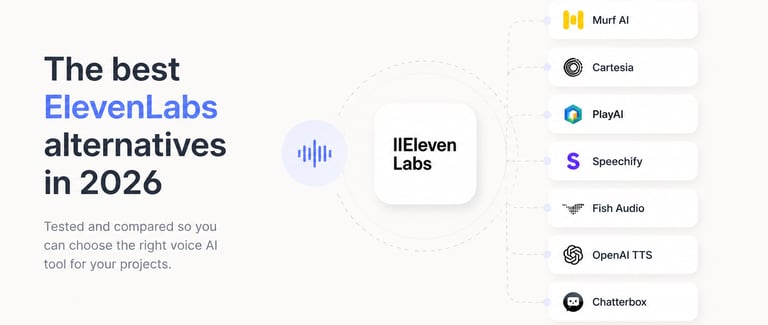
the best ElevenLabs alternatives (I tested the ones worth your time)
I like ElevenLabs. I want to say that before I spend an article telling you where to go instead. The voices are the best on the market. The voice cloning is scary good. For a one-off project where quality is the only thing that matters, I'd still reach for it. But the bill adds up fast.
ALTERNATIVES
Derek Callahan
6/11/202610 min read
Key takeaways:
ElevenLabs still has the most realistic voices, but you're paying a premium for the last 5% of quality that most projects don't need
Murf is my pick for creators and marketing teams who want a full voiceover studio rather than a bare voice API
Cartesia is the one to beat for real-time voice agents, with response times near 40ms that ElevenLabs can't match at the same price
PlayAI gives you 800+ voices and a huge language range, though the support complaints are real and worth knowing about
Speechify wins for anyone who mainly wants to listen to documents, not produce audio for an audience
The cheapest credible options (Fish Audio, OpenAI TTS, open-source Chatterbox) now score above ElevenLabs' faster models on blind quality tests
I like ElevenLabs. I want to say that before I spend an article telling you where to go instead.
The voices are the best on the market. The voice cloning is scary good. For a one-off project where quality is the only thing that matters, I'd still reach for it.
But the bill adds up fast. The Creator plan covers maybe 100,000 characters, which sounds like a lot until you're producing a weekly podcast or narrating long-form video. Hit the ceiling and the overage pricing stings. I've watched a faceless YouTube channel's TTS cost climb past their hosting bill.
So if you're here because the math stopped working, or you need something ElevenLabs doesn't do well (real-time agents, listening to your own PDFs, a proper editing studio), here's what I'd actually use. I've grouped these by who they're for, because "best alternative" depends entirely on what you're making.
A quick honesty note before I start: I haven't run every one of these at full production scale across every language. Voice quality is also partly taste. Test 2 or 3 with your own scripts before you commit to anything.
1. Murf AI
Murf is the one I recommend most often to creators and marketing teams. What sells it is everything wrapped around the voice.
You get a timeline editor, a built-in video sync tool, pitch and pace controls per sentence, and pronunciation tweaking. ElevenLabs hands you a voice. Murf hands you a small studio. If you're producing narrated explainers or course content and you don't want to bounce audio between four different apps, that gap matters more than whether a vowel sounds 3% more human.
The voices are genuinely good. Not quite ElevenLabs-tier on the most emotional reads, but close enough that your audience won't clock it, and the per-sentence controls let you fix the spots that sound flat.
What I like:
Full voiceover studio with video sync and timeline editing
Per-sentence pitch, pace, and emphasis controls
200+ voices across many languages
Clean enough that a non-technical teammate can use it solo
What I don't like:
The best voices sit behind higher tiers
The Studio interface can lag on bigger projects
Annual billing and auto-renewals catch people off guard
Pricing: Free tier to test. Paid from $19/month (Creator, billed annually). Business runs $66/month.
Murf holds a 4.7/5 on G2 across more than 1,000 reviews, and a 4.7 on Trustpilot too, though the Trustpilot sample is smaller at 186. The praise is consistent: JoeInOregon called it the "best 30 bucks i have spent in a wile," using it for phone tree and voicemail messages.
The criticism is just as consistent, and it's worth reading before you buy. Tiara D liked the voices but said "the actual Studio interface is a total nightmare to navigate," with lag while syncing text blocks to video. And Dana C flagged the thing that shows up over and over in negative reviews: "the high prices and automatic credit card charges feel like a total 'gotcha'." If you sign up, set a calendar reminder before the renewal date.
2. Cartesia
Cartesia is what I'd build a voice agent on right now, and it's not close.
The whole platform is tuned for one thing: speed. Their Sonic models stream audio back in roughly 90ms, and Sonic Turbo gets near 40ms even under load. For a phone bot or a live AI avatar, that's the difference between a conversation and an awkward pause every time the bot talks. ElevenLabs has low-latency models too, but Cartesia is the latency leader and usually cheaper per character for this use case.
The reason it's fast is genuinely interesting. The team spun out of the Stanford AI Lab and built their models on State Space Models instead of the transformer architecture everyone else uses. That keeps latency flat when traffic spikes, which is exactly when transformer-based voices tend to choke.
I'll be upfront about the catch. Cartesia is a developer tool. There's no friendly studio for clicking together a video voiceover. If you can't call an API or you don't have someone who can, this isn't your tool. And the headline 40ms number reflects ideal conditions. Independent production benchmarks put the real-world median closer to 188ms, which is still excellent, just not magic.
What I like:
Fastest streaming TTS I've tested, near 40ms with Sonic Turbo
Built on State Space Models, so latency holds up under load
Affordable API pricing, around $35 per million characters for Sonic
Strong fit for phone agents, avatars, and live interaction
What I don't like:
Developer-first, no consumer studio
Marketing latency numbers are optimistic versus production
Smaller voice library than the consumer-focused tools
Pricing: Free tier to start. Pro plan from $5/month (monthly) or $4/month annual. API usage billed per character.
Cartesia is newer and doesn't carry the thousands of G2 reviews the consumer tools do, so I'd weight hands-on testing over star ratings here. The signal I trust more is what builders say when they switch. In a thread about voice-to-voice alternatives, one r/aitubers commenter put it plainly: "seconding cartesia honestly. i switched from elevenlabs a few months ago and the quality difference" was worth it to them. That kind of unprompted endorsement from people running real workloads tells me more than a landing page.
3. PlayAI
PlayAI is the volume play. If you need a massive voice library and the widest language coverage you can get, this is the one to look at.
They offer more than 800 voices across 140-plus languages, and the engine has improved a lot. The newer models handle long-form narration and conversational reads well, and for high-volume audio work the per-word economics beat ElevenLabs comfortably. People producing audiobooks or large content libraries tend to land here.
Now the part I can't skip. The support reputation is rough. I read through dozens of reviews and the pattern is hard to ignore: great product, weak help when something breaks.
What I like:
800+ voices, 140+ languages, one of the widest ranges anywhere
Strong for long-form and high-volume audio
Real-time conversational voice models for agent use
Better cost than ElevenLabs at scale
What I don't like:
Customer support complaints are frequent and serious
The rebrand to PlayAI has muddied which plan is which
Some non-English voices still drift into robotic territory
Pricing: Free tier with 5,000 words/month (non-commercial). Professional from $39/month for 600,000 words. Premium $99/month.
PlayAI sits at 4.3/5 on G2, lower than the others here, and the support issues are why. One reviewer described being "locked out of accounts due to technical issues for weeks with no response while still being charged monthly." On Trustpilot, RISK ACADEMY reported "non existent technical and licence support" after a WordPress plugin stopped working with "no response for over a month."
It's a capable engine. I'd just go in knowing that if you hit a billing or access problem, you may be on your own for a while. For a hobby project that's annoying. For a business that depends on the audio pipeline, factor it in.
4. Speechify
Speechify is the odd one out on this list, and I'm including it because a lot of people searching for an ElevenLabs alternative don't actually want to produce audio. They want to consume it.
If your real goal is listening to articles, PDFs, emails, and documents in a good voice while you commute or do dishes, Speechify is built for exactly that. It reads anything you throw at it, works across phone, desktop, and browser extension, and has the celebrity voices (yes, Snoop Dogg) if that's your thing. It also has a Voiceover Studio for producing audio, but the listening experience is the reason to pick it.
The voices are solid. The reading-anywhere convenience is the actual product, and nothing on this list does it better.
What I like:
Best-in-class for listening to your own documents and articles
Works everywhere: mobile, desktop, browser extension
1,000+ voices across 60+ languages
Genuinely useful for people with dyslexia or visual fatigue
What I don't like:
More a reading tool than a production studio
The free trial to paid jump surprises people
Billing complaints are the dominant negative theme
Pricing: Free tier. Premium around $139/year (the monthly-equivalent annual deal). Voiceover plans priced separately.
Speechify carries a 4.7/5 on Trustpilot across a huge sample, 6,472 reviews, which is far more than any other tool here. The enthusiasts are real: Spairo has been on the Pro tier 2 years and called it "totally worth the money," explaining they "read a LOT for work and my eyes were just done by the end of the day."
But that same Trustpilot page has a loud minority furious about billing. sibby left a blunt one-star warning that "it is a scam that started with a £2 per month to £120 after the 7 day free trail." I don't think it's a scam, but the free-trial-to-charge flow clearly trips people. Read the terms before the trial ends.
5. WellSaid Labs
WellSaid is the enterprise and e-learning pick. If you're an instructional designer or you run L&D for a company, this is the tool built for you.
The voices are clean and consistent in a corporate-narration way. That's the point. WellSaid leans into reliable, broadcast-style reads rather than the expressive range ElevenLabs chases. For training modules and internal video, consistency beats drama. You want take 40 to sound like take 1.
It's also one of the few tools here that takes commercial licensing and rights seriously out of the box, which is why bigger companies in healthcare, manufacturing, and media keep showing up in the reviews.
What I like:
Polished, consistent voices made for corporate and e-learning
Clear commercial licensing and rights handling
Reliable output quality across long projects
Trusted by larger teams in regulated industries
What I don't like:
Expensive, and it doesn't pretend otherwise
Less emotional range than ElevenLabs or Cartesia
Overkill if you're a solo creator
Pricing: Creative plan around $50/month. Business runs $160/month. Enterprise is custom.
WellSaid holds a 4.6/5 on G2 across 124 reviews. The recurring verdict in those reviews is that it's pricey but earns it: one reviewer summed up the consensus as "a little bit high, but worth it," and an education buyer noted the budget approval was the only real friction. If voice quality and licensing safety matter more than saving money, that trade reads fine.
Honorable mentions
OpenAI TTS is the easy add-on if you're already in the OpenAI ecosystem. At roughly $15 per million characters it's cheap, the quality is respectable, and on blind tests it scores above ElevenLabs' faster Turbo and Flash models. Not the most expressive, but hard to argue with the price and convenience.
Fish Audio is the budget-quality surprise. Its S2 Pro model runs about $15 per million characters and rates above ElevenLabs Turbo on independent leaderboards. Free voice cloning too. Worth a look if cost is your main constraint and you still want above-average voices.
Chatterbox is the open-source option that genuinely beat ElevenLabs in a blind test, with 63.8% of listeners preferring it. It clones a voice from about 5 seconds of audio, supports 17 languages, and ships under an MIT license. You need to be comfortable running it yourself, but it's free and the quality is no joke.
Google Gemini TTS keeps coming up among people who just want cheap and good. It's tied into Google's stack, the voices are natural, and the pricing is friendly for high volume.
What Reddit is actually saying
I pulled these from real threads. Worth noting upfront: I couldn't open Reddit directly to grab each commenter's username this time, so I'm quoting the comments verbatim and linking each one to its source thread. The opinions are real, the links work, and you can see the handle yourself on the page.
On the eternal cost-versus-quality trade, one commenter in this r/aitubers thread on ElevenLabs alternatives said what most people eventually conclude:
"ElevenLabs quality is hard to beat but yeah it adds up. PlayAI's cheaper and decent for long-form."
For real-time work, the Cartesia recommendation in this r/aitubers voice-to-voice thread was unprompted and confident:
"seconding cartesia honestly. i switched from elevenlabs a few months ago and the quality difference..."
The budget-first crowd keeps pointing at the big cloud providers. From this r/ElevenLabs thread on cheaper TTS:
"Amazon Polly is cheaper than ElevenLabs. I tried it before and found that the voice quality..."
And from this r/generativeAI thread, a vote for Google that I've seen echoed a lot lately:
"Google Gemini's TTS service is the best I have found. And pretty cheap."
The self-hosting crowd has its own answer. In this r/LocalLLaMA thread titled "ElevenLabs is killing my budget", the top reply rattled off open-source picks:
"The best local options are: Soprano - fast, Kokoro - fast, Vibevoice, XTTS v2..."
The throughline across these threads is the same one I keep landing on: nobody disputes that ElevenLabs sounds best. They dispute whether the last sliver of quality is worth what it costs once you're producing at volume. For most people running the numbers, it isn't.
How to actually choose
Here's the short version.
Pick Murf if you're a creator or marketing team that wants a full studio, video sync, and voices a teammate can use without training. It's the most complete package for content.
Pick Cartesia if you're building a voice agent, phone bot, or live avatar and latency is the whole game. Nothing here responds faster for the money, as long as you can work with an API.
Pick PlayAI if you need raw scale: the most voices, the most languages, the best per-word cost for long-form. Go in aware that support is the weak spot.
Pick Speechify if you mainly want to listen to your own documents and articles in a good voice, anywhere, rather than produce audio for an audience.
Pick WellSaid if you're doing corporate or e-learning work where consistency and clean licensing beat emotional range, and the budget can handle it.
And if cost is the only thing driving you out of ElevenLabs, try OpenAI TTS or Fish Audio first. They're cheap, they're good enough for most projects, and they'll tell you quickly whether you ever needed to pay ElevenLabs prices in the first place.
One last thing, because the space moves fast. Pricing and model quality on this list will shift within months. Don't take my word as gospel. Run your real script through 2 or 3 of these, listen on the device your audience uses, and trust your own ears over any leaderboard.

Contact:
© 2026 toolpundit. All rights reserved.